
Victoria is building a thriving offshore wind sector, leading the way for Australia’s first offshore wind energy projects.
Offshore wind energy is generated by wind turbines placed in bodies of water, typically the ocean. Winds over water are stronger and more consistent than on land, and the turbines used are larger in size. This means that more electricity can be generated.
Undersea cables transport the electricity to an offshore substation, where a transformer steps up the voltage. High voltage undersea cables then transmit the electricity to an onshore substation where it is further processed so it can be connected into existing transmission infrastructure to power homes, industry and businesses.
To deliver offshore wind energy to Victorian homes we also need to make sure we have the right supporting infrastructure in place.
We need a dedicated port to construct and assemble the large and heavy turbines and other ports to support operations and maintenance.
Transmission infrastructure is also needed such as onshore transmission lines and substations.
The waters off Victoria’s coastline have some of the strongest and most consistent winds in the world, accompanied by relatively shallow ocean depths.
This makes Victoria ideal for offshore wind energy.As we move away from coal, different energy sources need to work together to keep our system strong. Offshore wind works well alongside solar, batteries and onshore wind. It can generate power in the evenings and in winter, when we need it most.
Offshore wind energy is a new and valuable addition to our energy mix and renewable energy transition. It will help us achieve our renewable energy targets, and be an important part of Victoria’s electricity future.
The first 2 gigawatts of electricity generated by offshore wind could power 1.5 million homes.
The Victorian Government has a legislated offshore wind energy generation target of 9 GW by 2040.
Offshore Wind Energy Victoria (OWEV) is responsible for coordinating the development of Victoria’s offshore wind industry.
It was established in December 2022 and is a division of the Department of Energy, Environment and Climate Action (DEECA).
Australia’s first offshore wind auction opened in August 2026 for projects off the Gippsland coast to bid for contracts to deliver Victoria’s first 2 GW of offshore wind energy generation – enough to power 1.5 million homes.
For more information on offshore wind energy, visit the Offshore Wind Energy Victoria (OWEV) website.
The Victorian Government has chosen the Port of Hastings as the main location for the construction and assembly of offshore wind infrastructure.
The proposed Victorian Renewable Energy Terminal will be a dedicated facility to receive, assemble, and deliver offshore wind components to offshore wind farms off the Victorian coastline.
Additional ports will be important for operations and maintenance. Ports such as Barry Beach Marine Terminal and Port Anthony, for example, could be suitable because they are close to the Gippsland offshore wind area.
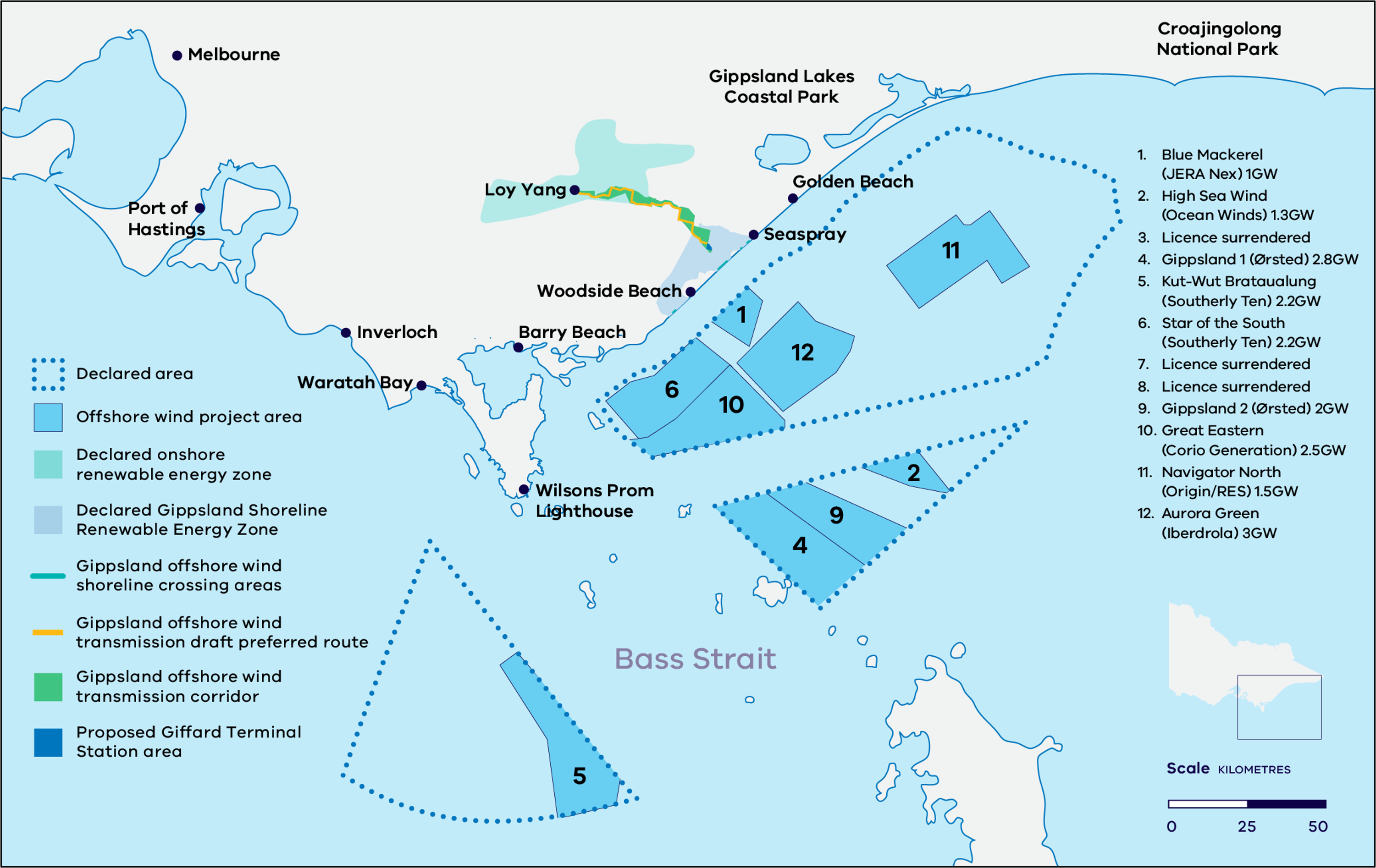
Source: Victoria's offshore wind rollout map (Source: Offshore Wind Energy Victoria)


